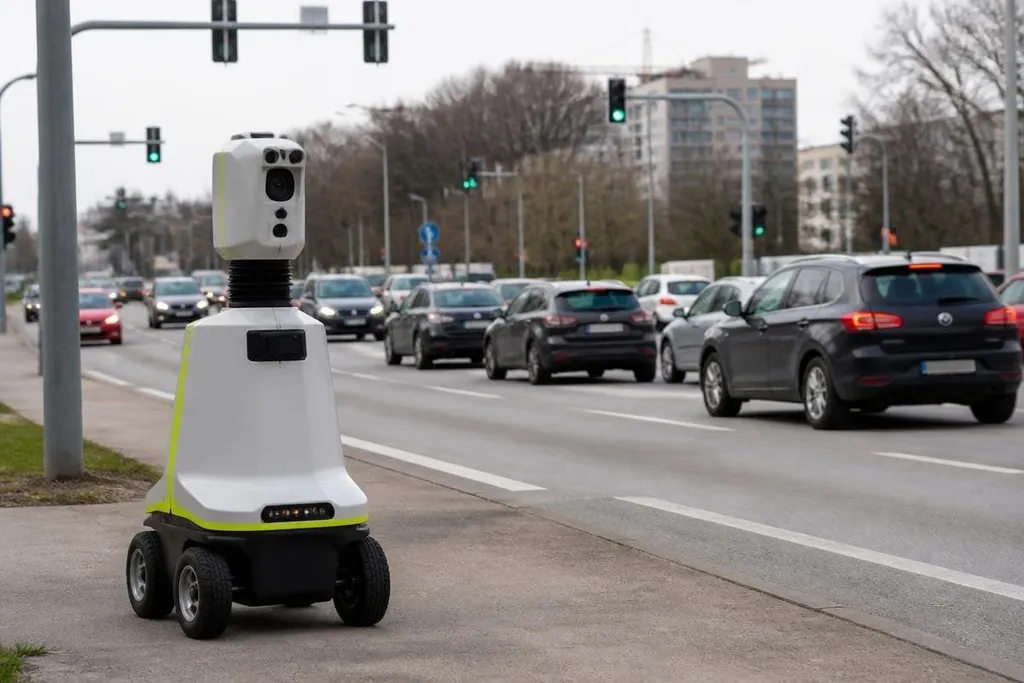
A traffic robot could watch road conditions, adjust signals, and warn drivers when a lane or junction changes. Its value would come from faster local decisions, not from replacing every traffic engineer or signal controller.
If you want to judge the idea clearly, start with the work it can do at the roadside and the limits that remain.
- Signals can react: sensors could help a junction respond to actual queues instead of a fixed schedule.
- Incidents get support: a robot could spot a stopped vehicle or blocked lane and send an alert.
- People still set rules: traffic teams would decide priorities, safety limits, and emergency plans.
What a traffic robot would do
The phrase “traffic robot” covers several kinds of systems. It might mean a roadside camera system, a small mobile robot, or software that controls signals after reading data from sensors. The shared idea is a machine that watches traffic and takes a defined action.
A junction system could read vehicle queues through cameras, radar, or road sensors. It could then change the length of a green signal within set limits. That matters when one approach has a long queue and another has few vehicles waiting.
The system could also watch crossings, bus lanes, roadworks, and blocked lanes. A roadside robot might send images or alerts to a control room.
Signal software could change the timing nearby. The work stays narrow: detect a condition, check it, then apply an approved response.
That narrow role is useful because traffic control already depends on rules. A machine can repeat those rules without asking a person to watch every junction at every moment.
Where the time savings could come from
Fixed signal timing can work when traffic follows a known pattern. It becomes less useful after a crash, road closure, large event, or sudden change in travel demand. A traffic robot could react to that change sooner than a scheduled review.
The first gain would come from queue control. If a sensor sees traffic building on one approach, the system could give that approach more green time while keeping a safe limit for other road users. The result would depend on the road layout, the sensor quality, and the rules set by the traffic team.
The same system could support buses and emergency vehicles. It might detect an approaching vehicle through approved signals and adjust a junction for a short period. That action would need clear limits so one priority request doesn't create a longer queue at the next junction.
Priority control can shorten one queue while moving the delay to another junction. Traffic robotics reporting should show the junction, signal system, test date, queue length, and human override behind any claim. Those facts set up the road limits that decide whether the system helps the wider network.
The limits are on the road, not in the brochure
Traffic robots need clean sensor data. Rain, glare, road spray, poor camera angles, and blocked signs can make a vehicle look different from what the system expects. A signal may then need human review instead of an automatic change.
Network effects also matter. Improving one junction can move a queue to the next one. A system that only sees its own intersection may reduce waiting there while making the wider route slower. Traffic teams would need shared data and rules across connected roads.
Safety adds another boundary. A robot should have a known response when its camera fails, its network connection drops, or its readings disagree. The safe action may be to keep a tested signal plan and alert a person, not to keep making changes.
Privacy needs a clear rule too. Cameras can support traffic control without storing more personal data than the job needs. Any deployment should state what the system records, how long it keeps that data, and who can access it.
A practical test before buying
A transport team comparing a traffic robot with a signal upgrade can check these points:
- Name the task: choose queue control, incident alerts, bus priority, or another specific job.
- Set the fallback: write down what happens when power, sensors, or communications fail.
- Measure the whole route: check nearby junctions, crossings, buses, and emergency access.
- Check the data: record what cameras and sensors collect, then set a deletion period.
- Run a limited trial: compare waiting time, queue length, false alerts, and staff workload before wider use.
I'd support traffic robots for narrow, measured tasks before giving them control across a whole road network. The useful proof will be a published trial showing fewer vehicle minutes lost without longer waits for buses, pedestrians, or the roads next door.